
Social Computing Journal
Save   Register Now & Subscribe to the SCJ Newsletter!
 
  TOPICS
    Blogs & Blogging
    Collaboration Tools
    Conferences
    CXO Viewpoint
    e2tv
    Enterprise 2.0
    From the Editor
    Government 2.0
    Lifestreaming
    Mashups
    Mobile Web 2.0
    Opinion
    SCJ Feature
    SCJ News
    Semantic Web
    Social Networking
    Tagging
    Virtual Worlds
    Web 2.0 Startups
    Web Video
    Wikis
    Wisdom of Crowds
      Feed
  CALENDARS
    Upcoming Events
    Forthcoming Books
  COMMUNITY
    Main Board
    Off-Topic Board
  SOCIAL MEDIA
    Bloggers
    Mailing Lists
    Photofeeds
    SoC Bibliography
    SoC Lexicon
    Video Sharing
    Virtual Worlds
    Who's Who
    Wikis
  SITE FEATURES
    Your Settings
  ABOUT US
    Advertising Info
    Contact Us
    Editorial Board
    Forgot Login?
    Submit News
Enterprise Social Media Usage Policies and Guidelines
Feedback   Author Bio   Printer-Friendly   E-Mail Article
Enter Your E-Mail Address:  

Friday, May 1, 2009; Posted: 12:25 AM - by Laurel Papworth

Enterprise Social Media Usage Policies and Guidelines

I've recently done a few press (radio, print) interviews on this topic, so I thought I should have another look at how Enterprise, Government, Corporates, Not for Profits are handling the fact that their staff are members of social networks too.

This list includes policies called: Staff blogging policies, enterprise social network guidelines, Employee Blogging Policies, Staff engagement in online communities, and so on.

I once had to step in to calm down a forum that was off the charts with negativity and general unpleasant comments. To be even heard, I started to IP and MAC address ban anyone who posted under secondary IDs for the purpose of trolling (making up a temporary persona who's only purpose is to create negative comments).

I shouldn't have been surprised - victim number one was the entire Customer Service department. Yep, they had been using their CSR PCs to create secondary accounts to attack members - customers - who were criticising them on their official, primary, Customer Service profiles. No-one got reinstated until we had "the talk."

Kinda cool that companies are now posting internal policies publicly. Not surprising - it goes a long way to protect the company from fallout if/when staff do ignore the social media guidelines in place.

Anyway, you could just read ONE - IBM's (love the "don't forget your day job") OR you can read all these: (download PR Crisis Comms social media courseware)

Behavioural and Etiquette Guidelines for Organisation

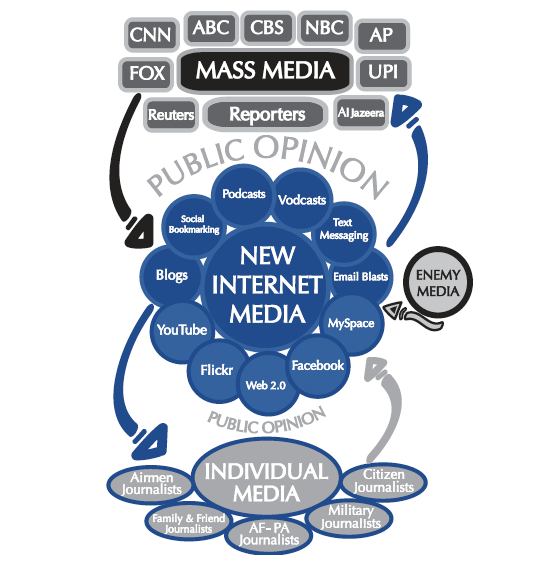
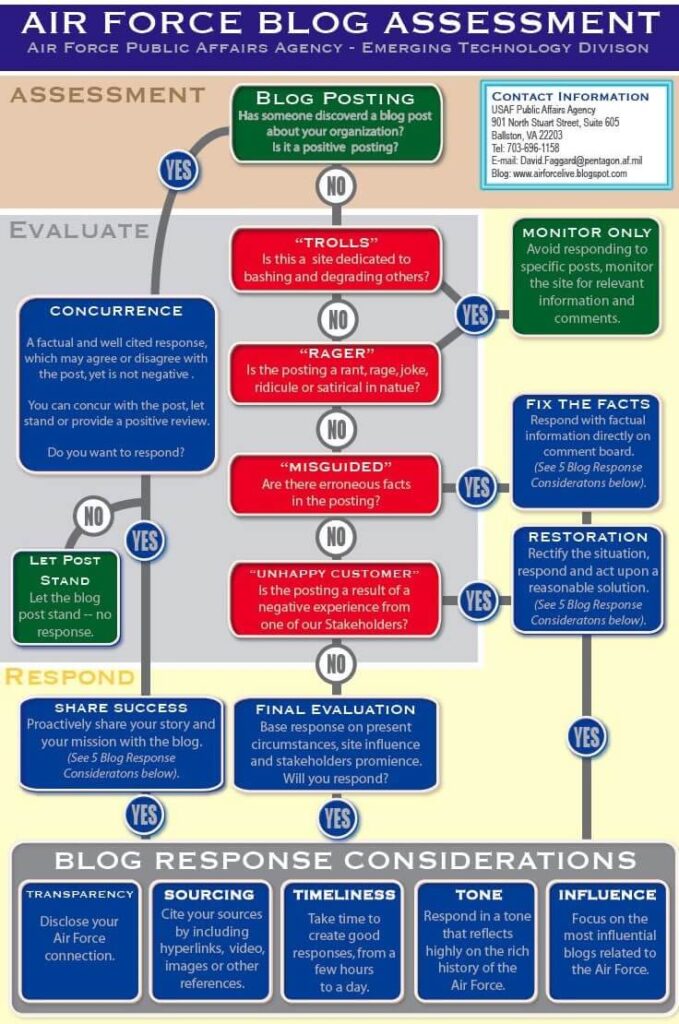
It's worth looking at the US Airforce one seperately, if just for the pictures alone.

enemy-blogsEnemy Media? ^.^
airforce-guidelines-policyI thought I blogged this chart before? Drat the internal search

AUSTRALIAN

Other lists: Christyweb, Beth Kantor, LGEO Research,

It's worth, while working your way through these links not to just look at the usual topics

Topics covered in Social Media Policies

  • defamation, anti competitor, inaccuracies, disclosure, proprietary information, company secrets and IP, wasting time, inappropriate behaviour, rudeness, revealing personal information and so on
  • Look for the unusual
    eMail Forwards
    Jokes, urban legends and get-rich email forwards are the oldest form of Internet-based social media. When it comes to company email, we ask that you think twice before hitting send and be judicious with the number of items you forward. And, if you're unsure whether the Prince of Nairobi really is being truthful about a promised fortune, a quick stop by Snopes.com might be in order. (Gretemangroup)

also look at

Fundamentals of Social Media Policies

  • Is the policy collaborative - telling staff what they can and can't do in their own time might require some discussion.
  • Is the policy positive, teaching engagement in a satisfying way between staff and customers or is it negative with a bunch of Thou Shalt Not Post Pictures on Facebook During Your LunchBreak? Tone IS important - is it fun to read, informative and everyday speech? Do you engage with your staff as you would with customers on a blog - authentic personal respectful voice?
  • Is it truly public and does it serve the staff or the company? For example, if I trashtalk Widget company, a community member might point out I am a competitor and then send me to my own companies public guidelines. Yes, that does happen.
  • Does the policy extend to contractors? Pilots who fly the senior people around, can't trashtalk them on the pilots forum. The advertising agency can't post up a viral video of how their ex-customer is a jerk because they didn't get their pitch? (Both have happened. I have the screenshots. Heh.)
  • Are the guidelines, now public, under creative commons so other companies can use them and help provide a fully informed educated ecosystem community?
  • Look at all the different names for basically one document. Email Policies becomes Social Media Policies, no?
  • Check out how different industries - tech, education, military, government, art, public affairs - are prioritizing their guidelines. What is included, what is top of the list, how does it change?

That should keep you busy for a while.

(The reason I have the full link here, is because I print it up and hand it out with courseware in the Social Media Policies For Your Organisation workshops that I run. If you want to do the same, please attribute me and the other aggregators. Thanks.)

There's not quite 40 Guidelines here. I guessed 40 because I know that some of you will have others. I'm particularly looking for Australian social media guidelines for staff.

Originally published on Laurel Papworth: The Business of Being Social.

Your Feedback:
Become part of the community, join the discussion...
blog comments powered by Disqus

Author Bio:

Laurel PapworthLaurel is one of Australia's top social media strategists, a renowned keynote speaker and respected thought leader on the business of being social.

Laurel consults at the executive level and facilitates strategic workshops on the impact of social networks on industry sectors, teaches marketing, blogging and social media courses for companies and runs workshops for small and home business on behalf of the Australian Government.

Laurel also mentors TV and Film social network projects at the Australian Film and Television School as well as teaching Marketing and blogging courses at the University of Sydney, and has taught Social Media as part of a Masters of Convergent Media at the University of Western Sydney. She currently runs workshops in Singapore, Shanghai and Malaysia with government and media companies on innovation and cross media.


Past Articles by This Author:

HOT STORIES THIS WEEK
The False Question Of Attention Economics
When Will 'Social Business' Become Social Change Business?
  ADVERTISEMENT
Hinchcliffe & Company - Pragmatic Enterprise 2.0 Consulting, Strategy, and Implementation for Social Media and Social Computing
  SCJ NEWS DESK
The DoD Pushes For Pervasive Social Collaboration
Government 2.0 Offers 'Unprecedented Opportunity' Says Task Force
How Social Computing Will Improve the Enterprise Value Chain: 8 Predictions
McAfee says Enterprise 2.0 is 'vital' to business; de-emphasizes 'social'
Tibco Introduces a New Social Computing Tool Called 'tibbr'
New Series Explores Enterprise Mashups, Open Standards, and IT Innovation
Andrew McAfee's Enterprise 2.0 Book Is Delayed By Six Months
New Study Finds Grassroots Enterprise Social Media Often Works Best
Web 2.0 University Week Coming to Las Vegas in October 2009
New Collaborative Research and Innovation Tool for Scientists Unveiled
  ADVERTISEMENT
  QUICK POLL
What is your favorite/most highly valued social networking tool for business?
LinkedIn
Digg
Delicious
Twitter
Facebook
Blogs

Contact us. All Materials Creative Commons (CC)2007-2010 Social Computing Journal.
This site is optimized for 1024x768 and higher resolutions. Privacy Policy.