
Ever thought about how the exponential growth of scientific research output is increasing? In the landscape of academic publishing, the growth is huge. So, the need for research integrity. The current pace of growth demands a mechanism that ensures accuracy, transparency, and accountability. One of the most influential initiatives dedicated to this mission is Retraction Watch. It is a platform that monitors, reports, and analyzes retractions of scientific papers.
Retraction Watch has become an essential resource for researchers, editors, institutions, and policymakers. It helps them to understand errors and misconduct in scholarly communication.
What is Retraction Watch?
Retraction Watch is a database that tracks and lists retracted or corrected publications or publications with an expression of concern. It has a connected blog that lists retracted publications. It was founded in 2010 by science journalists Ivan Oransky and Adam Marcus. It was acquired by Crossref in September 2023.
The platform focuses on:
- Reporting retracted academic papers
- Investigating scientific misconduct
- Highlighting corrections and ethical concerns
- Promoting transparency in scholarly publishing
This platform highlights retractions and encourages accountability within the academic community.
Why Retractions Matter
A retraction occurs when a published paper is formally withdrawn from the scientific record. Retractions may result from:
- Honest errors (e.g., miscalculations, flawed data)
- Data fabrication or falsification
- Plagiarism
- Ethical violations
- Duplicate publication
Someone may think that retractions are negative, but that is not the case. These retractions demonstrate that the self-correcting nature of science is functioning properly. However, transparency about the reasons behind retractions is essential for maintaining public trust in research.
The Retraction Watch Database
Retraction Watch has a comprehensive database that compiles thousands of retracted papers across disciplines.
The database allows users to:
- Search retracted articles by author, journal, institution, or country
- Analyze trends in retractions
- Identify patterns of misconduct
- Study systemic issues in academic publishing
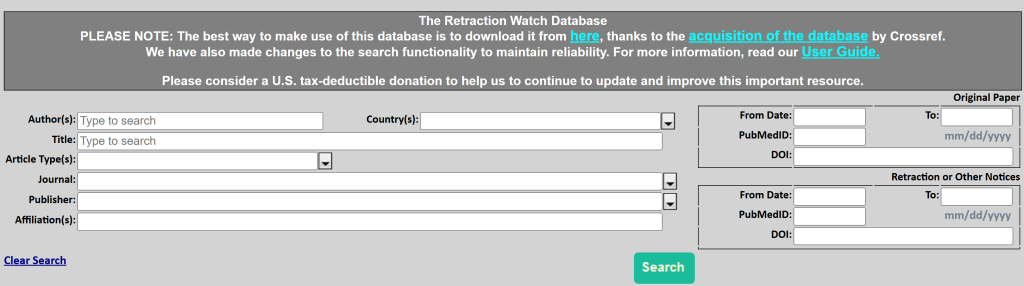
- The Retraction Watch Database
Related: How to Search Author on Scopus
Impact on Research Integrity
The impact of retraction watch database is huge in academia. It has influenced scholarly publishing in several ways:
- Encouraging journals to provide clearer retraction notices
- Increasing awareness of research misconduct
- Supporting whistleblowers and investigative journalism
- Highlighting problematic peer-review practices
By publicly documenting cases, the platform fosters dialogue about improving editorial standards and research ethics.
Trends in Retractions
Over the past decade, the number of retractions has increased. This rise does not necessarily indicate that misconduct is growing; rather, it may reflect:
- Improved detection technologies (e.g., plagiarism software)
- Greater scrutiny of published research
- Increased willingness of journals to correct the record
- Heightened public and institutional accountability
Retraction Watch plays a critical role in tracking and contextualizing these trends.
Criticisms and Challenges
Is everything fair about the Retraction Watch Database? No, there are concerns about it. Despite its positive impact, Retraction Watch has faced some criticisms, including concerns about:
- Public reputational damage for researchers
- Legal challenges related to reporting
- The complexity of distinguishing misconduct from honest error
It is worth mentioning that the platform maintains transparency, and responsible reporting is vital to protecting scientific credibility.
The Future of Research Transparency
With the spread of information, the need for oversight mechanisms grows stronger. Retraction Watch represents a shift toward greater transparency in academic publishing.
By documenting retractions and encouraging ethical reform, it contributes to a healthier research ecosystem. This system acknowledges mistakes, corrects them openly, and continually strives for higher standards.
Conclusion
Retraction Watch has become a central voice in discussions about research integrity and scientific accountability. By systematically tracking retracted publications and reporting on ethical issues in academia, it strengthens the self-correcting nature of science. In these times, transparency is not optional- it is foundational.